> For the complete documentation index, see [llms.txt](https://docs.arkelectron.com/llms.txt). Markdown versions of documentation pages are available by appending `.md` to page URLs; this page is available as [Markdown](https://docs.arkelectron.com/products/flight-controller/arkv6x-rt.md).
# ARKV6X-RT
{% hint style="info" %}
The ARKV6X-RT is a flight-controller module. It needs a Pixhawk Autopilot Bus carrier, such as the [ARK Pixhawk Autopilot Bus Carrier](/products/flight-controller/ark-pixhawk-autopilot-bus-carrier.md). Wiring connectors (GPS, TELEM, CAN, PWM, Ethernet, power) are on the carrier. See the [ARK Pixhawk Autopilot Bus Carrier Pinout](/products/flight-controller/ark-pixhawk-autopilot-bus-carrier/pinout.md).
That pinout labels signals with ARKV6X names, such as `UART5` on TELEM2 and `I2C3` on the I2C3 connector. The ARKV6X-RT names are different. Use the [Serial Port Mapping](#serial-port-mapping) and [I2C Bus Mapping](#i2c-bus-mapping) tables on this page.
{% endhint %}
The USA-built ARKV6X-RT is an NXP i.MX RT1176 variant of the [ARKV6X](/products/flight-controller/arkv6x.md), based on the [FMUv6X-RT and Pixhawk Autopilot Bus open source standards](https://github.com/pixhawk/Pixhawk-Standards). Triple synced IMUs make data averaging, voting, and filtering possible. The Pixhawk Autopilot Bus (PAB) form factor lets the module sit on any [PAB-compatible carrier](https://docs.px4.io/main/en/flight_controller/pixhawk_autopilot_bus.html).
[PX4 Autopilot](/products/flight-controller/arkv6x-rt/px4-instructions.md) ships on the board. Rev 1.0 is the revision in production.
{% hint style="warning" %}
Rev 2.0 has different IMUs than Rev 1.0. Rev 1.0 uses an ICM-45686, an IIM-20670, and an LSM6DSV80X. Rev 2.0 uses three LSM6DSV32X IMUs.
{% endhint %}
Order from [ARK Electronics](https://arkelectron.com/product/arkv6xrt/).
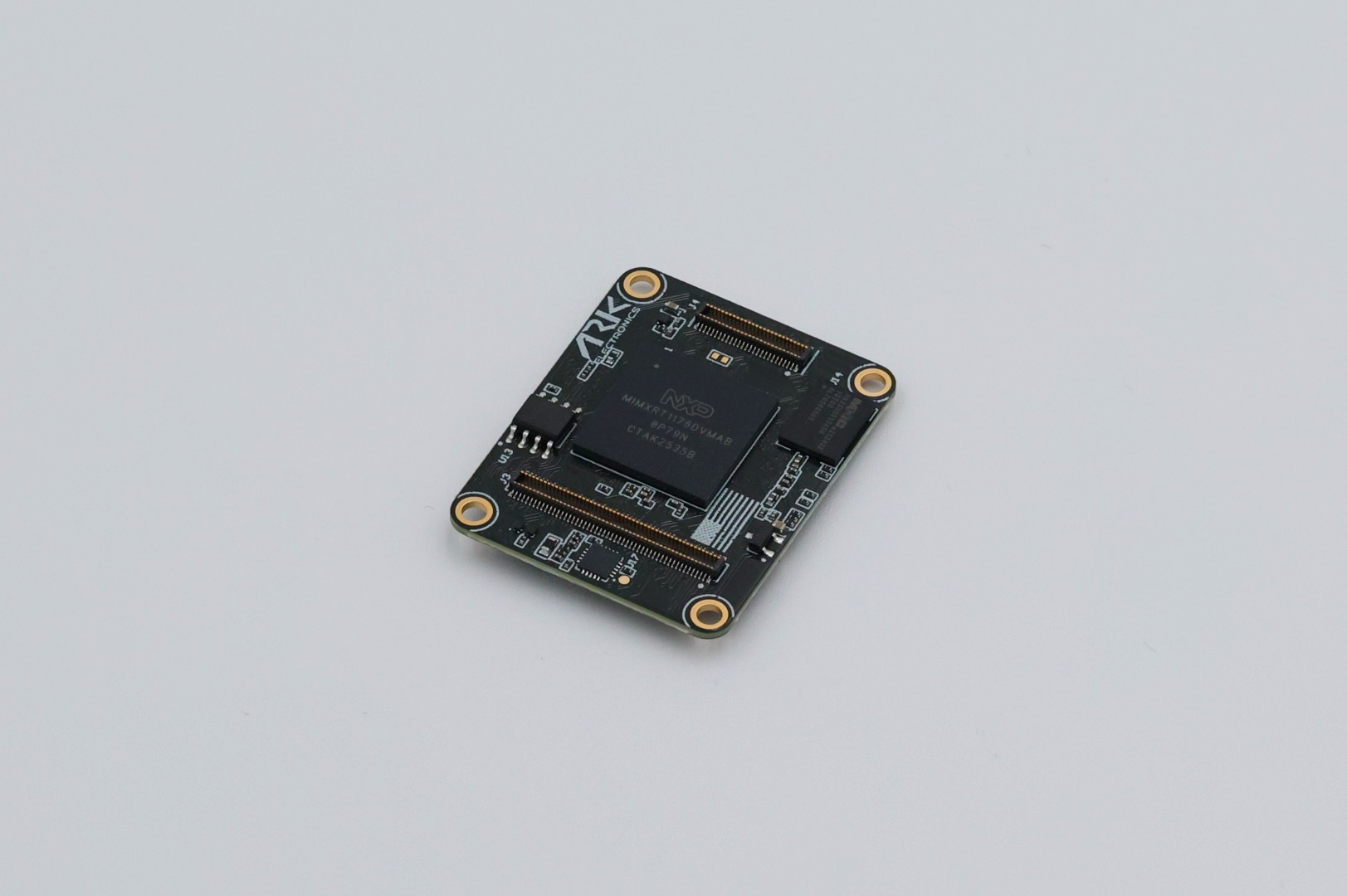
ARKV6X-RT Rev 1.0, PAB connector side
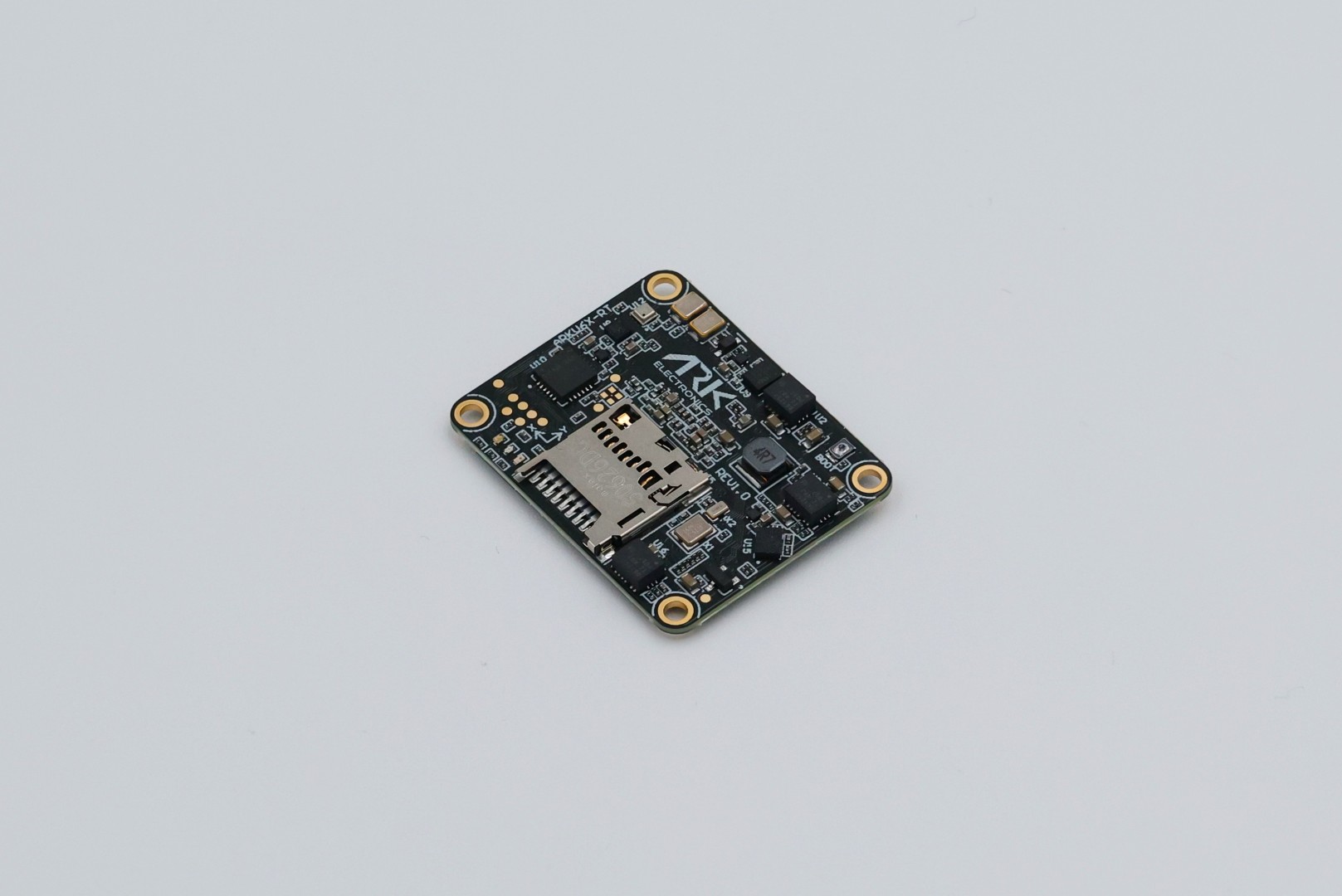
ARKV6X-RT Rev 1.0, MicroSD side
### Revisions
Rev 1.0 and Rev 2.0 share the processor, memory, magnetometer, heater, and PAB connectors. The sensor set and the barometer bus change.
| | Rev 1.0 (shipping) | Rev 2.0 |
| ---------------------- | -------------------------------------------------------------------------------------------------------------------------------------------- | -------------------------------------------------------------------- |
| IMU, SPI1 | [ICM-45686](https://www.invensense.tdk.com/en-us/products/6-axis/icm-45686) | [LSM6DSV32X](https://www.st.com/en/mems-and-sensors/lsm6dsv32x.html) |
| IMU, SPI2 | [IIM-20670](https://www.invensense.tdk.com/en-us/products/motion-tracking/6-axis/iim-20670) | LSM6DSV32X |
| IMU, SPI3 | [LSM6DSV80X](https://www.st.com/en/mems-and-sensors/lsm6dsv80x.html) | LSM6DSV32X |
| Barometer | [BMP390](https://www.bosch-sensortec.com/products/environmental-sensors/pressure-sensors/pressure-sensors-bmp390.html) on I2C2, address 0x76 | BMP390 on I2C3, address 0x76 |
| Magnetometer | [IIS2MDC](https://www.st.com/en/mems-and-sensors/iis2mdc.html) on I2C3, address 0x1E | IIS2MDC on I2C3, address 0x1E |
| FMUM hardware revision | 0 (`ARKV6XRT000`) | 1 |
Each IMU has its own SPI bus, power rail, and data-ready line. On Rev 2.0 the BMP390 shares I2C3 with the IIS2MDC. The two parts use different addresses.
PX4 starts the Rev 1.0 IMUs when the hardware type is `ARKV6XRT000`, and it probes the BMP390 on I2C2. Rev 2.0 needs a build that recognizes FMUM revision 1. See [PX4 Instructions](/products/flight-controller/arkv6x-rt/px4-instructions.md).
### Processor
* [NXP i.MX RT1176](https://www.nxp.com/products/i.MX-RT1170), MIMXRT1176DVMAB
* 1 GHz Arm Cortex-M7. PX4 clocks this core at 996 MHz.
* 400 MHz Arm Cortex-M4. PX4 clocks this core at 392.73 MHz and leaves it idle.
* 2 MB RAM
* Code store is a 64 MB Macronix MX25UM51345G octal NOR on FlexSPI1. The RT1176 fetches instructions from that flash (execute-in-place). PX4 uses the first 4 MB.
* [NXP EdgeLock SE051](https://www.nxp.com/products/SE051) secure element, I2C address 0x48
### Sensors
Rev 1.0, the revision that ships:
* [Invensense ICM-45686](https://www.invensense.tdk.com/en-us/products/6-axis/icm-45686) on SPI1. ±32 g / ±4000 dps. Primary IMU, and the heater sense point.
* [Invensense IIM-20670](https://www.invensense.tdk.com/en-us/products/motion-tracking/6-axis/iim-20670) on SPI2. ±65.5 g / ±1966 dps.
* [ST LSM6DSV80X](https://www.st.com/en/mems-and-sensors/lsm6dsv80x.html) on SPI3. PX4 publishes the ±16 g / ±4000 dps channel. The part's ±80 g element is left off. High-g coverage on this revision is the IIM-20670.
* [Bosch BMP390](https://www.bosch-sensortec.com/products/environmental-sensors/pressure-sensors/pressure-sensors-bmp390.html) on I2C2, address 0x76
* [ST IIS2MDC](https://www.st.com/en/mems-and-sensors/iis2mdc.html) on I2C3, address 0x1E
Rev 2.0 replaces U9, U10, and U15 with three [ST LSM6DSV32X](https://www.st.com/en/mems-and-sensors/lsm6dsv32x.html) IMUs (±32 g / ±4000 dps) on the same three SPI buses, and moves the BMP390 to I2C3.
### Other Features
* Infineon FM25V02A FRAM, 256 Kbit (32 KB), on FlexSPI2. PX4 stores parameters here.
* [Pixhawk Autopilot Bus (PAB) form factor](https://github.com/pixhawk/Pixhawk-Standards/blob/master/DS-010%20Pixhawk%20Autopilot%20Bus%20Standard.pdf)
* 100-pin Hirose DF40C-100DP-0.4V(51)
* 50-pin Hirose DF40C-50DP-0.4V(51)
* 1 W heater on 5 V, about 200 mA, for warming the sensors in extreme cold
* Red, green, and blue LED indicators
* MicroSD slot. A MicroSD card is included.
* Onboard boot button. The boot mode is read only at power-on or reset. Hold the button while powering on to select the ROM serial downloader. Otherwise the board boots from the programmed fuses.
* USA built, NDAA compliant
### Interfaces
These signals are on the PAB connectors. A carrier decides which of them reach a jack.
* 12 FMU PWM outputs. A carrier with PX4IO adds 8 more.
* Eight serial ports: GPS1, GPS2, TELEM1, TELEM2, TELEM3, TELEM4, PX4IO/RC, and the debug console
* Four I2C buses: I2C1, I2C2, I2C3, and I2C6. I2C3 is internal and holds the onboard IIS2MDC. On Rev 1.0 the BMP390 is on I2C2, which also runs to the carrier GPS2 and POWER2 connectors. On Rev 2.0 the BMP390 is on I2C3. See [I2C Bus Mapping](#i2c-bus-mapping).
* SPI1, SPI2, and SPI3 serve the onboard IMUs. SPI6 is the external bus, with two chip selects, two data-ready lines, and a reset.
* CAN1, CAN2, and CAN3. The default PX4 build enables two CAN interfaces.
* 100BASE-T Ethernet on ENET2. The module drives RMII, PHY power, and the PHY interrupt. The PHY, magnetics, and jack are on the carrier.
* USB
* MicroSD
* SWD and the system console, on the carrier FMU Debug connector
### Power Requirements
* 5 V, from the carrier
* 500 mA
* 300 mA for the main system
* 200 mA for the heater
### Additional Information
* Weight: 5.0 g
* Dimensions: 3.6 x 2.9 x 0.5 cm
### Pinout
The board-to-board pinout is the [DS-010 Pixhawk Autopilot Bus Standard](https://github.com/pixhawk/Pixhawk-Standards/blob/master/DS-010%20Pixhawk%20Autopilot%20Bus%20Standard.pdf).
GPS, TELEM, CAN, PWM, Ethernet, and power connectors are on the carrier.
{% content-ref url="/pages/8FoCumpSHonz9iz7bpP3" %}
[Pinout](/products/flight-controller/ark-pixhawk-autopilot-bus-carrier/pinout.md)
{% endcontent-ref %}
### Serial Port Mapping
PX4 on the ARKV6X-RT. Flow control is CTS/RTS on the TELEM ports that have it. The last column is the connector and signal name on the [ARK PAB Carrier pinout](/products/flight-controller/ark-pixhawk-autopilot-bus-carrier/pinout.md), which uses ARKV6X UART names.
| UART | Device | Port | Flow control | ARK PAB Carrier connector (pinout label) |
| -------- | ---------- | ------------- | :----------: | ---------------------------------------- |
| LPUART1 | /dev/ttyS0 | Debug Console | No | Debug Port (Console TX/RX) |
| LPUART3 | /dev/ttyS1 | GPS1 | No | GPS1 (`USART1`) |
| LPUART4 | /dev/ttyS2 | TELEM1 | Yes | TELEM1 (`UART7`) |
| LPUART5 | /dev/ttyS3 | GPS2 | No | GPS2 (`UART8`) |
| LPUART6 | /dev/ttyS4 | PX4IO / RC | No | RC/SBUS (`USART6`) |
| LPUART8 | /dev/ttyS5 | TELEM2 | Yes | TELEM2 (`UART5`) |
| LPUART10 | /dev/ttyS6 | TELEM3 | Yes | TELEM3 (`USART2`) |
| LPUART11 | /dev/ttyS7 | TELEM4 | No | UART4/I2C3 (`UART4`) |
{% hint style="info" %}
The bootloader brings up LPUART8 only, at 1,500,000 baud. UART flashing uses the carrier TELEM2 connector. See [PX4 Instructions](/products/flight-controller/arkv6x-rt/px4-instructions.md).
{% endhint %}
### I2C Bus Mapping
PX4 bus numbers, as used by driver `-b` options and parameters such as `PCA9685_EN_BUS`.
| PX4 bus | ARK PAB Carrier connectors | Onboard devices |
| ------- | -------------------------- | ---------------------------------------- |
| 1 | GPS1, POWER1 | None |
| 2 | GPS2, POWER2 | Rev 1.0: BMP390 at 0x76 |
| 3 | None (internal) | IIS2MDC at 0x1E. Rev 2.0: BMP390 at 0x76 |
| 6 | I2C3, UART4/I2C3 | None |
The carrier's `I2C3` connectors are bus 6 on the ARKV6X-RT, not bus 3. Bus 3 is internal. A PCA9685 on the carrier I2C3 connector needs `PCA9685_EN_BUS` set to 6.
On Rev 1.0, don't put another device at address 0x76 on GPS2 or POWER2, such as a barometer in a GPS module. It would collide with the onboard BMP390.
---
# Agent Instructions
This documentation is published with GitBook. GitBook is the documentation platform designed so that both humans and AI agents can read, navigate, and reason over technical content effectively. Learn more at gitbook.com.
## Querying This Documentation
If you need additional information that is not directly available in this page, you can query the documentation dynamically by asking a question.
Perform an HTTP GET request on the following URL with the `ask` and `goal` query parameters:
```
GET https://docs.arkelectron.com/products/flight-controller/arkv6x-rt.md?ask=&goal=
```
`ask` is the immediate question: it should be specific, self-contained, and written in natural language.
`goal` is what the user is ultimately trying to achieve, the reason they need the answer. Sharing it helps GitBook give you a better, more relevant answer. A goal is most helpful when it describes the outcome the user wants rather than restating the question. For example, with `ask=how do I create an API token`, a goal like `build a script that syncs our docs to a CMS` lets GitBook tailor the answer to that use case.
The response will contain a direct answer to the question and relevant excerpts and sources from the documentation.
Use this mechanism when the answer is not explicitly present in the current page, you need clarification or additional context, or you want to retrieve related documentation sections.